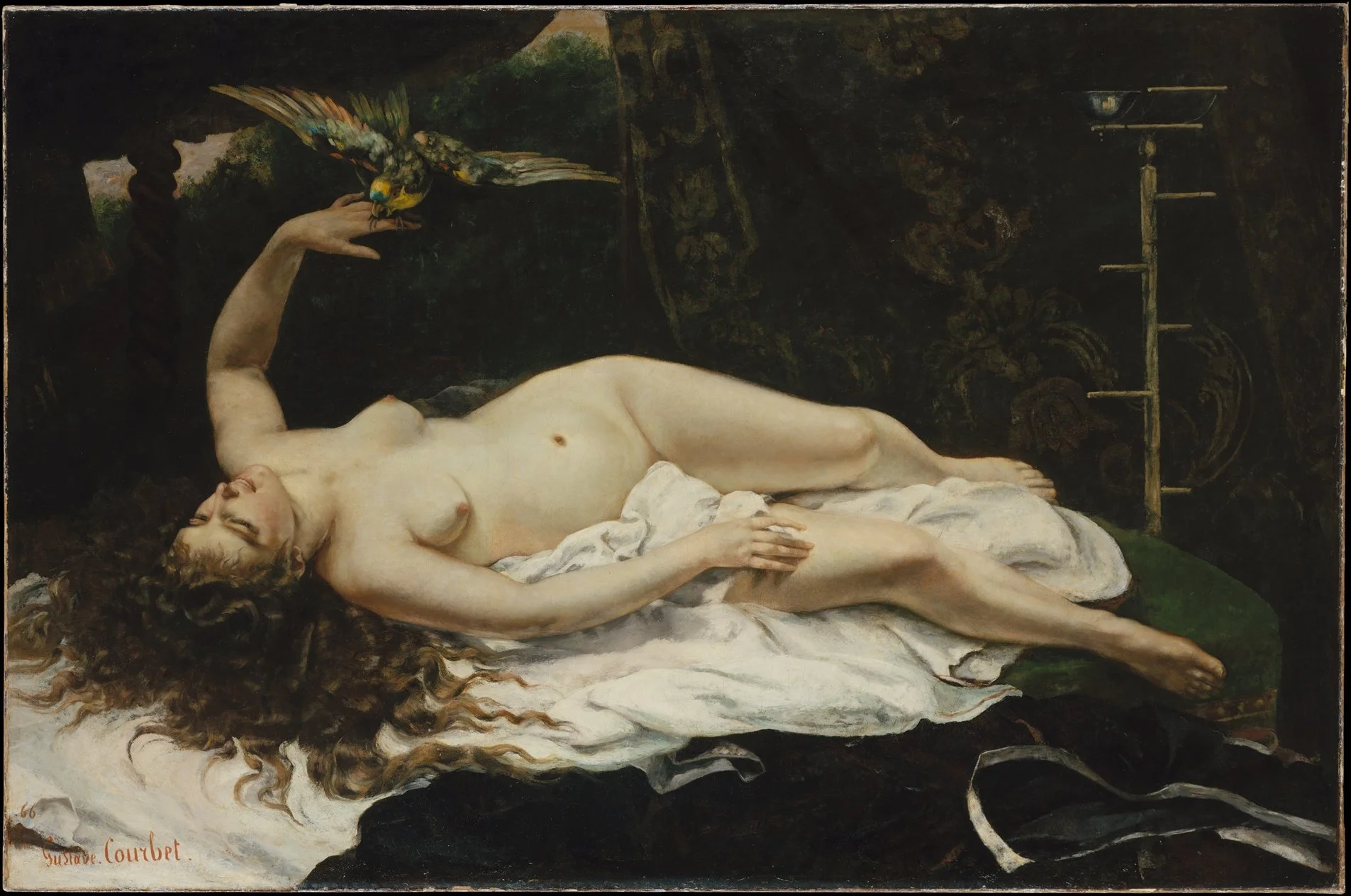
Woman with a Parrot (1866) by Gustave Courbet repositions female sexuality and agency by employing traditional notions of Aphrodite in their specific meanings, while rejecting classical visual form. Ideological residue mixes with realism to justify the ordinary woman’s place in high art, especially when rendered nude. Rather than resorting to mythological narrative and academic idealization, Courbet reconstructs the female body through artistic technique and different usage of symbolic references. Aphrodite, in this image, is therefore transported to a realm of universality that refrains from limiting ideological forces.
Woman with a Parrot was initially rejected by the Paris Salon as indecent and not accepted until two years later. Courbet, a radical figure in his views and in his work, was faced with mixed reactions, positive and negative, largely due to the realistic nature of his work along with his refusal to adhere to the academic idealization of the female nude. Whether or not Courbet’s woman is still degrading and subjective rather than outspokenly feminist remains debatable because, universally speaking, the female body is perceived as “the object of male pleasure and the bearer of male lack” (Snow 30). The meaning of this work fluctuates and can be altered depending on the type of audience and cultural forces surrounding it. The eroticism and sensuality depicted remains undeniable precisely through the painting’s rebellion.
Courbet’s Woman With a Parrot presents viewers with an entanglement of the male gaze. Largely characterized by feminist theory, the male gaze builds itself on themes of patriarchal ideology and voyeurism. Still, it must be noted that “a feminism not attuned to internal difference risks becoming the instrument rather than the abrogator of that law” (Snow 31). To an extent, Courbet’s work underscores the tendencies of “‘feminist analysis’ reduction of masculine vision to negative terms,” highlighting the potential ways it might reinforce the ideologies it aims to challenge. The artist’s emphasis on the model’s physical dishevelment and twisted pose, reflects attitude as its own constructive force. Her carelessness and indifference towards the audience holds a new kind of power. The male gaze in regard to feminist theory, is a complex puzzle of sameness and otherness occupied by both genders in different and similar ways. “In some intrapsychic as well as intersubjective sense,” Snow says, “there may be always two who look” (39).
Despite Courbet’s distinguished visual code, he retains the classical element of editing out his model’s genitalia and pubic hair. His work depicts a nude woman spread out on wrinkled white sheets that recall the drapery often found framing the body of Aphrodite. His strategic employment of the sheets appears to share the same purpose as the classical drapery covering Aphrodite. By doing so, Courbet is actively acknowledging his consideration of the academic idealization of the female nude. And yet, other works by Courbet, such as L’Origine du monde (1866) may suggest his genitalia editing of Woman With a Parrot is deliberate. There to tie his female nude to the traditional canon. Despite this connection, Courbet severs it through his model’s attitude: she is not concerned with posing for her audience, nor does she seem aware of one. Her raised arm implies vulnerability and openness, signaling to us that she is actively situated in a scene of spontaneity within this private encounter.
Wings spread, perched on her fingertips, lies a parrot, “the most lascivious bird of them all” (Shefer 447). Symbolically speaking, the bird is first framed through psychoanalysis and the miraculous aspects of the natural world. Exploration of the various symbolic meanings of birds must first be concerned with their representation and role in the human unconscious. Freud mentions the bird in reference to masturbation, “since the sensation of flying and phallic erection are similar” (Wagner 98). Furthermore, the bird is “more heavenly and the migratory customs of birds of passage are more enigmatic to him than those of others.” The juxtaposition between the parrot and the corporeal, informally posed model it rests on, suggests that Courbet’s work establishes a concrete alternative of the female nude. He is actively choosing to diverge from the traditional canon. More specifically, he is challenging the conventional dialogue between painting and viewer, allocating more agency to the female nude in appearance and meaning.
Symbolism of the bird can be applied several ways and depending on context, offers
different levels and kinds of sexual meaning. The bird in the cage, for instance, is often presented with the subject of a young girl. Sometimes the cage could represent love or the female organ, the bird signalling virginity; “let the bird escape and you have a loss of virginity” (Shefer 447). The bird in the cage also finds correspondence between female and male genitals or direct intercourse.
In later works, the same idea can be conveyed “in the ubiquitous theme of the “woman at the window,”” with the home symbolizing the cage. More specifically, the boundaries blocking women from freedom but disguised as protection by the patriarchal society. With this in mind, the woman becomes the pet herself and the basis for the iconography that follows. When the birds are depicted outside of the cage, especially when women are depicted “playing with or feeding them, these paintings may have hinted at more erotic meanings, that is, that the pets are for sale” (Shefer 467). Some artists even “show how the bird cage was painted on signs to advertise a house of ill repute, the place where men came “to bird” women” (Shefer 448). The activity taking place between the woman and the parrot creates the notion that Courbet’s woman is more than an ordinary woman—she’s a prostitute. One that shares the essence of Aphrodite.
Speaking of sexual agency, Roy’s text, “An Alternative Sexual Morality for Classical Athenians” suggests that Athenian women were able to manipulate sexual code and convention. He discusses the complex cultural forces of classical Athens by navigating dynamics of illicit sexual behavior with a heavier emphasis on the role women play. Highlighting that the perception of “good” and “respectable” in Classical Athens is revealed specifically through the social and sexual codes of gender. Women who engaged in sexual activity for profit were known as Hetairai and yet those sexual roles weren’t confined to a singular definition. They are better measured on a spectrum. Such blurring of social convention is emphasized by Antisthenes’ daring claim that, “Aphrodite has corrupted many fine and good women,” which, to some extent subjects all Athenian women, who were not sexually naive, to eroticism and suggests their participation in desire outside of the household (Roy 13). Courbet’s ordinary, corporeally depicted woman, harnesses remnants of Aphrodite and all Athenian women. Carving out the idea that sexual culture exists beyond the division of respectable and unrespectable women. Or rather, wives, lovers, and prostitutes.
In Courbet’s painting, there is not a cage but a constructed stand for the bird to climb or entertain itself on. The outstretched positioning of the woman's arm and the fluttering wings of the parrot, suggests she is interacting in a playful manner. As opposed to feeling shame, the model appears at ease, content even. Her upward gaze is complimented by the fluttering wings of the parrot, the painting’s largest source of movement and activity. Although she is lying on her back, her attention is directed onto the parrot. She looks up as if the answers to her thoughts lie in the parrot; or in the sexual activities and history its presence signifies. Meaning the parrot serves as the catalyst to her thoughts. This interpretation can be cemented by noting that the parrot occupies the most poignant burst of color in the painting itself. Symbolizing opportunity, allure, and excitement, Courbet’s energetic strokes of greens, blues, reds, and yellows, give the bird a heightened value, while suggesting motion and fragility. Courbet provides the parrot with its own palette, highly contrary to the muted, fleshy tones taken up by the rest of the painting. Further in regards to technique, Courbet chooses to make his strokes visible and lived in, in opposition to the invisible strokes prioritized in the academic artistic realm. His brushwork with oil paint, emphasizes the constructed nature of the image and the evidence of his strategic labor.
The laissez faire style of the woman’s hair reveals Courbet has manipulated it only for the purpose of the painting itself: wild, long, fanned out as opposed to neatly combed back or pulled up. Courbet’s depiction of hair parallels his models' pose, the wrinkled sheets, the bird out of the cafe. Collectively offering disorder as a form of intimacy and truth. Disorder is further depicted in not only the pose of the model but the way her legs stretch out. One leg is nestled in the background, while the other leans off the edge of the bed or sofa she is resting on. Somewhat paralleling the traditional contrapposto stance, where one leg bears more weight than the other. Small details, such as this one, recall Courbet’s consideration of the way Aphrodite is traditionally depicted in both painting and sculpture. His usage of a dark, mysterious curtain as the backdrop also enhances the sculptural feel of the model's figure while illuminating her fleshiness and imperfect skintone. The contours of her torso are softened through his use of light, falling softly over her body.
The light originates from the left hand side and also highlights the model’s rounded, liberated breasts. Neither large nor small, her breasts appear to rest within the posture of her outstretched body. The trajectory of the female breast’s significance in the arts contains valuable insight for cultural narratives. The female breast is inextricably linked to the body but can simultaneously exist as a separate entity to be employed for socio-political exploration. Reading the breast is particularly important because rather than depicting female beauty and sexuality in its simplest form, viewers can extract new meaning in the context of cultural conflicts specifically regarding the turmoil of gender conventions.
The model’s breast size emphasizes Courbet’s correspondence between high art, Aphrodite, and the real woman. Interestingly, his model is not directly reflective of Aphrodite nor depicted as particularly low class. Lower class women often worked as wet nurses, breastfeeding babies during their fertile years while “only noble women had the luxury not to nurse and thus preserve their breasts,” going out of their way to acquire potions and creams that would help “maintain the shape and tonus of their breasts” (Yandell 543). With this in mind, breasts devoted to suckling babies would not be depicted in the plump and perky manner Courbet presents. Additionally, the breasts depicted are not in frontal view or reminiscent of the still-like breasts found on traditional reclining nudes.
In classical iconography, the breasts promote human symmetry and grace, while also suggesting timelessness. The superiority found in ideal human perfection can be readily dissected in statues like Sandro Botticelli’s Birth of Venus (1486). Although Venus is emerging from chaos, “the rounded likes of the breasts recall circles, the form of perfection cherished by both artists and Neoplatonic philosophers” and works towards “the harmonious whole in this personification of human beauty as a reflection of spiritual and intellectual worth” (Yandell 541). The goddess’s pudica pose also creates a sense of circular movement, further extenuated by the placement of the long strands of her hair. The nakedness of Courbet’s woman is therefore interlocked with the idea of sexual transgression and taboo.
In her text, The “Bird in the Cage” in the History of Sexuality: Sir John Everett Millais and William Holman Hunt, author Elaine Shefer uses work by such artists to provide a foundation for her discussion of bird symbolism as it relates to female sexuality. She describes Miallai’s Waking or Just Awake (1865) firstly by examining the objects surrounding the girl that reflect “her youth and innocence: a doll, letters of the alphabet on the floor in front of her bed, a bouquet of flowers.” Next she notes the stability of this image is purposefully “shaken by the bird cage, which deliberately forces itself upon the viewer, in the upper right-hand corner of the painting” (Shefer 447). This could be interpreted as her sexual destiny looming, waiting to triumphantly transform her from girl to woman. “Lost innocence is inextricably bound up with the dead or wounded bird out of the cage,” signaling the irreversible and life altering transition.
Similarly, English eighteenth century paintings Portrait of Anne Russel by Sir John Russell (circa 1780s) and Lesbia or The Dead Sparrow by Sir Joshua Reynolds, represent their subject, a girl, mourning the death of her bird, potentially disguised as virginity. The loss of virginity often symbolizes entrance into adulthood, and for women specifically, comes with shame or grief. Courbet’s parrot, on the other hand, provides a sound and celebratory aspect to the painting. The woman depicted is not sad or in a state of mourning. She is neither shameful nor guilty but rather relaxed, curious, and present to her surroundings. The physical and emotional state she is in parallels the parrot’s fluttering wings, large in width, apparent in strength—a strength that transcends from the parrot to the female nude through her unapologetic stature.
By combining such observations, Courbet’s Woman with a Parrot becomes the ultimate reveal of how the classical nude and narrative of Aphrodite can be employed as a resistive force to diverge from its own traditional canon. By rejecting formality and replacing it with informality, Courbet presents us with a woman whose sexuality is present and self-possessive, as opposed to mythic and out of reach. The high altitude, playful activity, and symbolism of the parrot, works in conjunction with Courbet’s own “ideal” woman; a figure reflective of adventure, sensuality, and an indifference to how others perceive her body and sexual activity.
