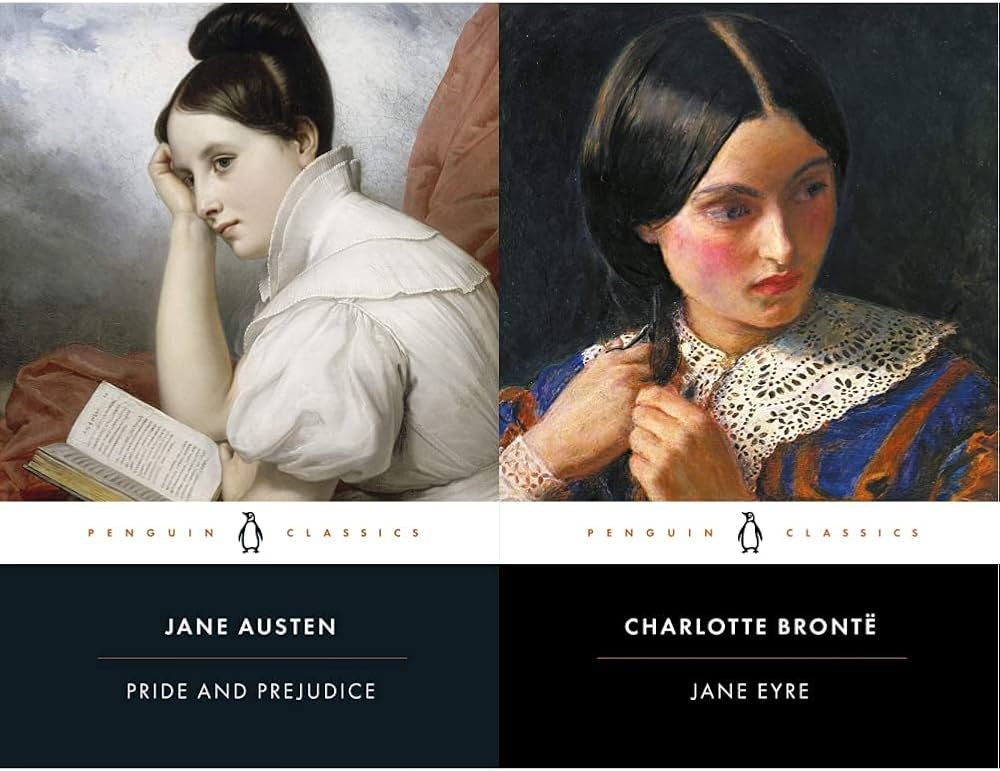
Both Jane Austen’s Pride and Prejudice and Charlotte Brontë’s Jane Eyre portray girlhood as a strategic performance governed by the “girl code,” enacted through gossip, glances, and silence. Although the two novels differ significantly in genre and tone, both feature the power of the code. Subtly woven into the text itself, the structure of female communication embodies a formula, reading more like an invisible rulebook that requires ongoing detection to reveal. By putting Austen and Brontë’s tales into conversation, a universal “girl code” emerges, and the concept of girlhood gains stronger scaffolding.
In Pride and Prejudice, Austen places reputation at the forefront, spotlighting social language as the strongest tool for class mobility and marriage, or in its simplest form: survival. “Girl code” in Austen’s novel, therefore, revolves primarily around social interactions and is vividly revealed through group settings. Our heroine, Elizabeth Bennet, is most aware that “reflection must be reserved for solitary hours” (Austen 147) and known for the “liveliness of [her] mind” (Austen 260). She is therefore pulled apart from her sisters and their mother, “whose weak understanding and illiberal mind” makes genuine connection difficult. Elizabeth’s mannerisms benefit from a mixture of reserve and wit, and her remarks are never without observation—signaling there is strategy in withholding, especially when one is female. Consequently, in Jane Eyre, Brontë revamps the code into a device for moral resistance and mental fortitude. Gossip, glances, and especially silence are explored with deeper psychological depth and cast in a dark light that adheres to the novel’s gothic core.
From the very beginning, Mrs. Reed demands Jane be “seated somewhere; and until [she] can speak pleasantly, remain silent” (Brontë 10), leaving a permanent residue that follows Jane to the very end of her journey: “I drew near houses; I left them, and came back, and again I wandered away: always repelled by the consciousness of having no claim to ask—no right to expect my interest in my isolated lot” (Brontë 377). To Mrs. Reed, being pleasant, or in the very least, tolerable, is synonymous with not asking questions and shutting down healthy forms of self-expression.
The hesitance and caution that define Jane’s character are tethered to her inability to express the knot of oppression that is meant to hold her back. When punished, Jane claims “[her] worst ailment was an unutterable wretchedness of mind: a wretchedness which kept drawing from me silent tears” (Brontë 25). Jane’s powerlessness is emphasized by Mrs. Reed’s decision to be “blind and deaf” on the subject of her son's abusive tendencies, which widens the scope within which “girl code” lies an established hierarchy. The confused, adolescent Jane compares only what she sees: “Eliza, who was headstrong and selfish, was respected. Georgiana, who had a spoiled temper, a very acrid spite, a captious and insolent carriage, was universally indulged” due to her beauty. Brontë adds an additional level, deepening the scale on which “girl code” sits: “All John Reed’s violent tyrannies, all his sisters’ proud indifference, all his mother’s aversion, all the servants’ partiality turned up in [Jane’s] disturbed mind like a dark deposit in a turbid well” (Brontë 18). Brontë’s decision to begin with John Reed and refer to the female relatives in the household as his cements the patriarchal foundation to which the code is attached. While Austen’s silence stems from social tactics, Brontë’s silence carries the hum of her heroine’s journey. Between Gateshead and Thornfield is Lowood, where Jane meets Helen and “wonder[s] at her silence” (Brontë 64). The moments between Jane and Helen suggest that
intimacy and mutual connections also come in the form of silence. Jane says, “I was silent: Helen had calmed me; but in the tranquility she imparted there was an alloy of inexpressible sadness” (Brontë 83), circling back to her own. Following Jane’s final departure is a remarkable rhythm, “No reflection was to be allowed now: not one glance was to be cast back; not even one forward” as she “skirt[s] the fields, and hedges, and lanes till after sunrise” (Brontë 369). Even after Jane crumbles to the ground for some minutes, she is “soon up, crawling forwards on [her] hands and knees, and then again to [her] feet—as eager and as determined as ever to reach the road” (Brontë 370). The momentum of Brontë’s writing here focuses on the intersection of struggle and silence. As Jane pioneers forward, her own body becomes the hurdle, highlighting the dynamic between self and social language. For Elizabeth, her body also serves as an obstacle to admitting her mutual love for Darcy.
The silence and resistance exercised by Elizabeth and Jane Eyre, specifically, suggest that sometimes not speaking at all is the only path out—particularly for those of lower socioeconomic status. Even in conversation with her sister Jane, whose reputation is positive but lacks depth because her politeness is so profound and consistent, Elizabeth ends up having to “listen in silence,” while contemplating the true nature of Miss Bingley and Mrs. Hurst, and is “not convinced” of their goodness because “their behavior at the assembly had not been calculated to please in general” (Austen 12). Similarly, when Jane Eyre visits Thornfield, she describes Eliza and Georgina’s “rather drawling tone” that is, “accompanied by sun-dry side-glances that measured [her] from head to foot—now traversing the folds of [her] merino pelisse. Brontë strategically uses “girl code” here to clarify Jane’s positioning—purposefully circling back to “the plain trimming of [her] bonnet” which contrasts to the sisters silk attire (Brontë 265). Additionally, attitude and wealth link together in her observation that “in each of the sisters there was one trait of the mother” (Brontë 263). Even when Jane meets Blanche Ingram, she writes, “her face was like her mother’s; a youthful unfurrowed likeness: the same low brow, the same high features, the same pride” (Brontë 200).
Brontë’s descriptions are loud but quiet, showing rather than telling us that productive looking in “girl code” relies on silence. When seeing the other ladies, Brontë describes them as having the “sweeping amplitude of array that seemed to magnify their persons as a mist magnifies the moon” (Brontë 199). Rather than depicting Jane as jealous, she depicts her as a being quietly overpowered by the headcount, tallness, and appearance before her. Still, Brontë informs her readers that Jane is well aware of the fact that “Young ladies have a remarkable way of letting you know that they think you a quiz’ without actually saying the words. A certain superciliousness of look, coolness of manner, nonchalance of tone, express fully their sentiments on the point, without committing them by any positive rudeness in word or deed” (Brontë 264). Jane’s reflection surpasses mere realization and stands alone as a statement that is at once silent and active, like the judgment she encounters.
Similar to Brontë, Austen employs the female concern for clothing. Elizabeth’s muddy arrival at Netherfield makes space for additional commentary. While Mrs. Hurst and Miss Bingley focus on “her petticoat, six inches deep in mud” (Austen 26), Bingley and Darcy interject without charged commentary. “It shews an affection for her sister that is very pleasing,” says Bingley, while Darcy remarks that Elizabeth’s eyes “were brightened by the exercise” (Austen 26). The responses from both gentlemen override what the sisters say, yet they remain distant. Their verbal contribution clashes with their sisters' gossip because it contradicts it. Both Austen and Brontë exclude men from “girl code” because they are incapable of understanding or speaking a language that is inherently female.
Although exempt from the code, the male characters retain the ability to intersect and magnify it. After reading (and rereading) Darcy’s letter, Elizabeth recoils rather than call out or confess her emotional state. Austen writes that “Elizabeth’s astonishment was beyond expression. She stared, coloured, doubted, and was silent” (Austen 131). In the same light, Jane Eyre retreats when Mr. Rochester reveals the issue of Bertha Mason. The night before Jane leaves, she is “transported in thought to the scenes of childhood” and endures “a mind impressed with strange fears” (Brontë 367). Both heroines struggle most to maintain emotional equilibrium, especially when their feelings are under the spell of love. In courtship, the way one looks is more telling than whatever words accompany it. For instance, Darcy infamously calls Elizabeth “tolerable; but not handsome enough to tempt [him],” precisely after “looking for a moment at Elizabeth, till catching her eye, he withdrew his own” (Austen 9). Consequently, when Darcy enters Mr. Bennet’s study, Austen writes that “[Elizabeth] sat in misery till Mr. Darcy appeared again, when, looking at him, she was a little relieved by his smile” (Austen 257).
In the case of Mr. Rochester, Jane says, “my eye met his as the idea crossed my mind: he seemed to read the glance, answering as if its imports had been spoken as well as imagined” (Brontë 158), though the genuine communication strikes a different chord and is not without performance. Jane’s adherence to “girl code” is reflected in her response: “instead of speaking, I smiled; and not a very complacent or submissive smile either,” and also in Mr. Rochester’s frustration— “‘Speak,’ he urged” (Brontë 156). Rather than being “complacent” or “submissive,” Jane uses the code to her advantage, and an additional power dynamic emerges. Like Bingley and Darcy, Mr. Rochester faces a blockade that embodies whatever visual or verbal cues are lost in translation.
Matters of seeing, therefore, are prone to misinterpretation—making the female eye particularly vulnerable to drama despite truth. Glances or prolonged gazes arguably hold the most power, as they encapsulate both silence and gossip. Austen’s initial descriptions of Miss Bingley highlight her capacity for trouble: “She then yawned again, threw aside her book, and cast her eyes around the room in quest of some amusement” (Austen 40). The combination of yawning and tossing a book demonstrates her entitlement to carelessness, while her gaze grips onto chords of silence and gossip. It is not surprising that moments later Miss Bingley encourages Elizabeth to “take a turn about the room” (Austen 41) and that her “dislike of [Elizabeth] had originated in jealousy” (Austen 181). The “girl code” is therefore structured as a formula—one does not function without the other. And while silence controls women internally, gossip or the threat of it governs them externally.
Alternatively, Austen brings a necessary attention to Darcy’s younger sister, specifically through the perspective of Elizabeth, who is surprised to see their shared embarrassment after having heard that “Miss Darcy was exceedingly proud” but through careful observation understands her as "exceedingly shy” (Austen 177). When joined by the other women at the table, Austen writes that “Georgiana’s reception of them was very civil; but attended with all that embarrassment, though proceeding from shyness and the fear of doing wrong, would easily give to those who felt themselves inferior, the belief of her being proud and reserved” (Austen 181). This scene is of particular importance because it brings awareness to the dangers of “girl code” and the mysteriously quick manner in which reputations and gossip may arise. However, because Elizabeth is well-versed enough in “girl code,” she is aware Miss Bingley is watching her closely and knows she “[cannot] speak a word, especially to Miss Darcy without calling her attention” (Austen 182). It must also be noted that at this moment, the notion of class is undermined by the universal filter female communication travels through.
Both narratives, therefore, argue that nineteenth-century girlhood is a state of eternal negotiation. Gossip, glances, and silence function together as conversational forces capable of pivoting plot points in ways that help and hurt the female characters. Most interestingly, the “girl code” that unfolds is at first glance trivial and frivolous—reinforcing the ideology of the concept itself. Again, upon closer examination, Austen and Brontë present a highly technical system of communication, proposed as a means of survival. Despite the two differing threads of “girl code” in each story, both authors suggest that a woman’s quest for autonomy cannot be successful without proper interpretation of the code. Elizabeth’s reserve, wit, and intelligence, and Jane Eyre’s emotional restriction, become forms of resistance, though the pattern of silence, gossip, and glances within each of their stories shamelessly reveal that girlhood is chained to “girl code” and will remain bound to its patriarchal platform.
